
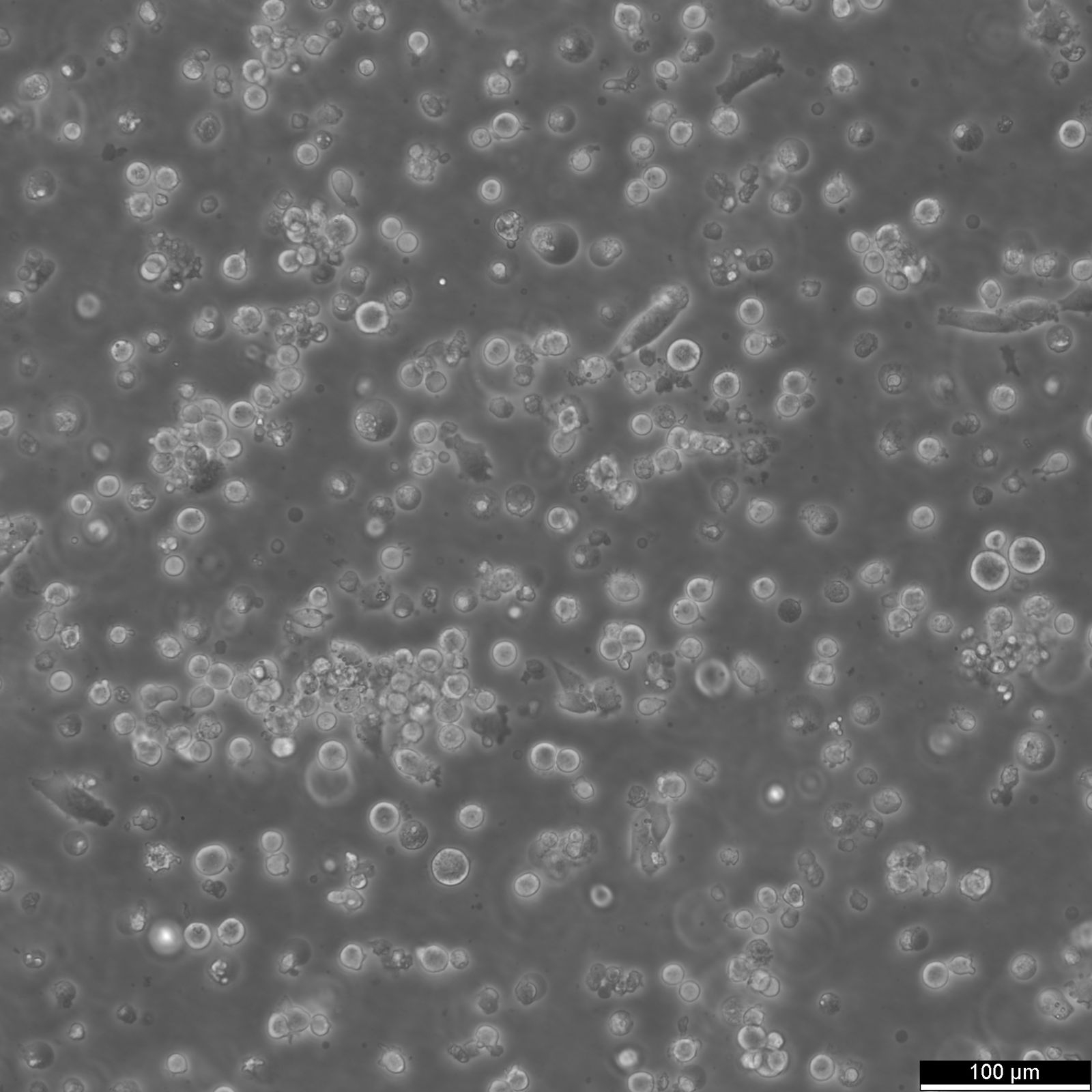
HEL 92.1.7 Cells
USD 395.00*
Products are shipped frozen on dry ice in cryotubes. Each cryotube typically contains 3 × 10⁶ cells for adherent lines or 5 × 10⁶ cells for suspension lines (refer to the batch CoA for details).
Información general
| Descripción | The HEL 92.1.7 cell line exhibits the capacity for spontaneous differentiation into erythroblast-like cells, mimicking some aspects of erythroid maturation in vitro. This characteristic makes them particularly useful for studying the erythroid differentiation process and the regulation of gene expression related to erythropoiesis. Their ability to spontaneously differentiate offers a unique advantage for studying the intrinsic pathways and mechanisms that drive erythroid precursor maturation without the addition of external differentiation-inducing agents. Moreover, the differentiation of HEL 92.1.7 cells can be further manipulated through the addition of phorbol esters such as TPA (12-O-tetradecanoyl-phorbol-13-acetate) and PMA (phorbol myristic acid), which are known to induce macrophage-like differentiation. This induced differentiation into macrophage-like cells expands the utility of the HEL 92.1.7 cell line beyond erythroid studies, allowing researchers to explore and understand the plasticity of hematopoietic cells and the conditions under which lineage commitment and cellular identity can be redirected. Such studies are crucial for developing therapeutic strategies aimed at manipulating cell fate for regenerative medicine and cancer treatment. |
|---|---|
| Organismo | Human |
| Tejido | Bone marrow |
| Enfermedad | Erythroleukemia |
| Sinónimos | HEL92.1.7, HEL-92.1.7, HEL-92-1-7, HEL-92_1_7, HEL-92, HEL92 |
Características
| Edad | 30 years |
|---|---|
| Género | Male |
| Origen étnico | Caucasian |
| Morfología | Round cells |
| Tipo de célula | Erythroblast |
| Propiedades de crecimiento | Suspension |
Datos normativos
| Referencia | HEL 92.1.7 (Cytion catalog number 300462) |
|---|---|
| Nivel de bioseguridad | 1 |
| NCBI_TaxID | 9606 |
| N.º de acceso de Cellosaurus | CVCL_2481 |
Datos biomoleculares
| Expresión de antígenos | HLA A3, Aw32, Bw35, Ia+ |
|---|---|
| Productos | Hemoglobin, globin (G gamma, A gamma, epsilon, zeta and alpha chains), beta-2-microglobulin, glycophorin |
Manejo
| Medio de cultivo | RPMI 1640, w: 2.0 mM stable Glutamine, w: 2.0 g/L NaHCO3 (Cytion article number 820700a) |
|---|---|
| Suplementos | Supplement the medium with 10% heat-inactivated FBS |
| Reactivo de disociación | Accutase |
| Subcultivo | Gather the suspension cells in a 15 ml tube and gently wash the adherent cells with PBS lacking calcium and magnesium (use 3-5 ml for T25 flasks and 5-10 ml for T75 flasks). Apply Accutase (1-2 ml for T25 flasks, 2.5 ml for T75 flasks) ensuring full coverage of the cell layer. Allow the cells to incubate at room temperature for 10 minutes. Following incubation, combine and centrifuge both the suspension and adherent cells. After centrifugation, carefully resuspend the cell pellet and transfer the cell suspension into new flasks containing fresh medium. |
| Renovación de fluidos | 2 to 3 times per week |
| Medio de congelación | As a cryopreservation medium, we use complete growth medium (including FBS) + 10% DMSO for adequate post-thaw viability, or CM-1 (Cytion catalog number 800100), which includes optimized osmoprotectants and metabolic stabilizers to enhance recovery and reduce cryo-induced stress. |
| Descongelación y cultivo de células |
|
| Atmósfera de incubación | 37°C, 5% CO2, humidified atmosphere. |
| Condiciones de envío | Cryopreserved cell lines are shipped on dry ice in validated, insulated packaging with sufficient refrigerant to maintain approximately −78 °C throughout transit. On receipt, inspect the container immediately and transfer vials without delay to appropriate storage. |
| Condiciones de almacenamiento | For long-term preservation, place vials in vapor-phase liquid nitrogen at about −150 to −196 °C. Storage at −80 °C is acceptable only as a short interim step before transfer to liquid nitrogen. |
Control de calidad y análisis molecular
| Esterilidad | Mycoplasma contamination is excluded using both PCR-based assays and luminescence-based mycoplasma detection methods. To ensure there is no bacterial, fungal, or yeast contamination, cell cultures are subjected to daily visual inspections. |
|---|
Certificado de análisis (CoA)
| Número de lote | Tipo de certificado | Fecha | Número de catálogo |
|---|---|---|---|
| 300462-090425 | Certificado de análisis | 23. May. 2025 | 300462 |
| 300462-190525 | Certificado de análisis | 21. Jul. 2025 | 300462 |