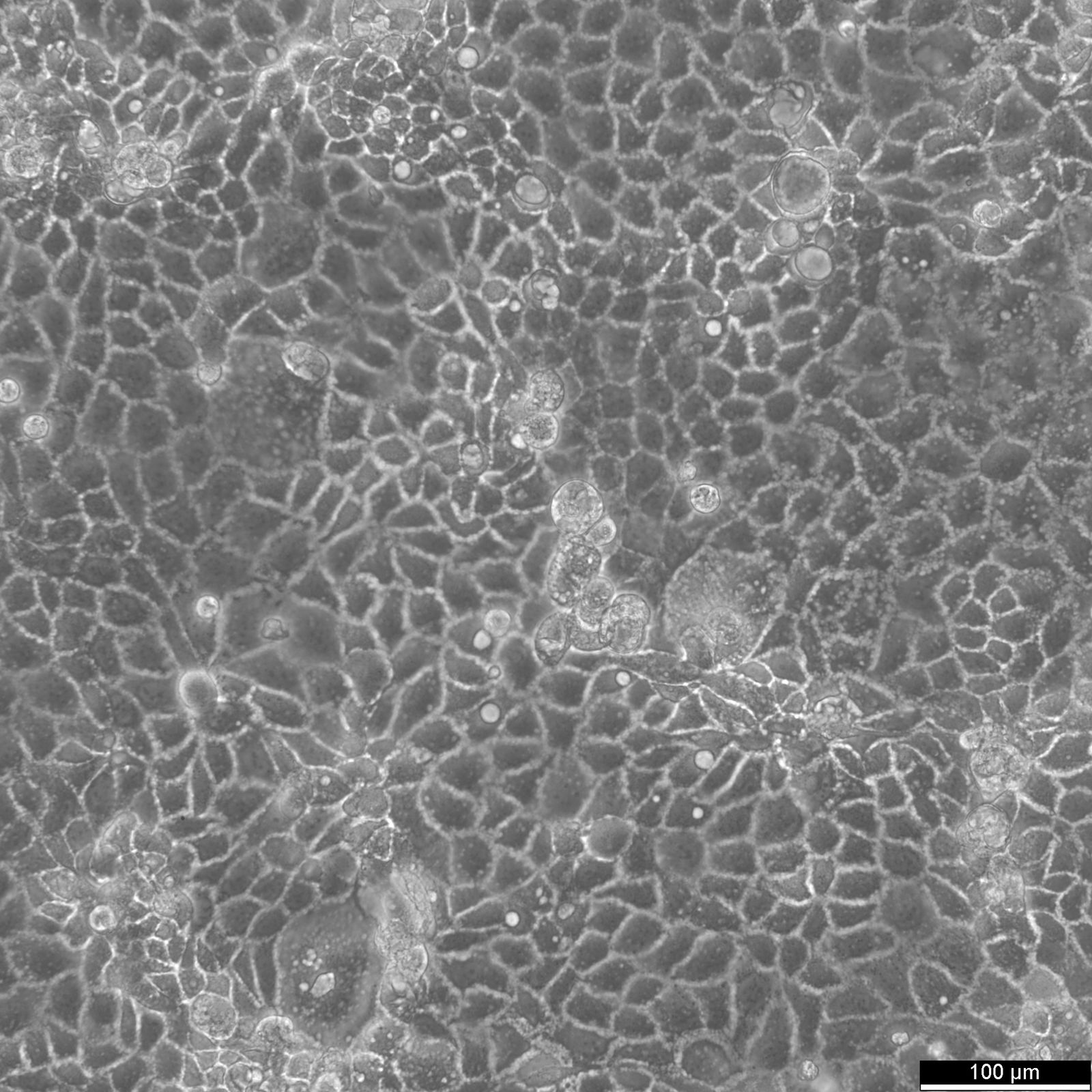
HT-29 Cells
USD$395.00*
Products are shipped frozen on dry ice in cryotubes. Each cryotube typically contains 3 × 10⁶ cells for adherent lines or 5 × 10⁶ cells for suspension lines (refer to the batch CoA for details).
Overview of the HT-29 cell line
| Description | The HT-29 cell line, derived from a Grade II human colorectal adenocarcinoma, represents a cornerstone research model in the study of human colon cancers. Derived from a primary tumor in a 44-year-old female in 1964, HT22 cells have been instrumental in advancing our understanding of the adhesion or invasion mechanisms of cancer cells. As a human adenocarcinoma cell line, HT-29 cells exhibit characteristics that closely mimic those of mature intestinal cells, such as enterocytes, underscoring their utility in exploring the dynamics of food digestion and nutrient bioavailability. HT-29 cells are sensitive to conventional colorectal cancer chemotherapies, including 5-fluorouracil and oxaliplatin. This sensitivity, coupled with their ability to express differentiation pathways under specific conditions, such as glucose deprivation or treatment with inducers like butyrate, makes them an invaluable model for investigating the molecular mechanisms underlying cell differentiation and cancer progression. Moreover, HT-29 cells have been utilized as a xenograft tumor model, providing a platform for in vivo studies that mimic the tumor's behavior in the human body. This application allows for the exploration of tumor growth, metastasis, and the efficacy of therapeutic agents in in vivo situations. In summary, the HT-29 cell line is a pivotal tool in medical and biological research, facilitating a deeper understanding of human colon adenocarcinoma, the molecular basis of cancer cell differentiation, and the development of effective cancer treatments. |
|---|---|
| Organism | Human |
| Tissue | Colon |
| Disease | Adenocarcinoma |
| Synonyms | HT 29, HT29 |
Specifications
| Age | 44 years |
|---|---|
| Gender | Female |
| Ethnicity | Caucasian |
| Morphology | Epithelial-like |
| Growth properties | Adherent |
Documentation
| Citation | HT-29 (Cytion catalog number 300215) |
|---|---|
| Biosafety level | 1 |
| NCBI_TaxID | 9606 |
| CellosaurusAccession | CVCL_0320 |
Genomics of the colorectal adenocarcinoma cell line HT29
| Receptors expressed | Urokinase receptor(u-PAR), vitamin D (moderate expression), no detectable plasminogen activator activity. |
|---|---|
| Protein expression | CEA negative, p53 positive |
| Antigen expression | Blood Type A, Rh+, HLA A1, A3, B12, B17, Cw5, CD4 -, cell surface expression of galactose ceramide (a possible alternative receptor for HIV) |
| Isoenzymes | Me-2, 1, PGM3, 1-2, PGM1, 1-2, ES-D, 1, AK-1, 1, GLO-1, 1-2, G6PD, B, Phenotype Frequency Product: 0.0230 |
| Oncogenes | Myc+, ras+, myb+, fos+, sis+, p53+, abl -, ros -, src - |
| Tumorigenic | Yes, in nude mice. Forms well differentiated adenocarcinoma consistent with colonic primary (grade I), tumors also form in steroid treated hamsters |
| Virus susceptibility | Human immunodeficiency virus (HIV, LAV) |
| Products | Secretory component of IgA, carcinoembryonic antigen (CEA), transforming growth factor beta binding protein, mucin, The p53 antigen is overproduced |
| Karyotype | The stemline chromosome number is hypertriploid with the 2S component occurring at 2.4%. Seventeen marker chromosomes are found in most metaphases, generally in single copy per chromosome. The marker designations are: M1p-(=t(3p-,?) with a deleted short arm), t(7q,?), t(10q,?), i(13q), 19q+a. M6, ?t(8q,9q-), ?xp, M9, 6q+, t(13,?)a, t(13,?)b, 19q+b, M14, M15, 15p+, and xq-. Chromosome 13 is nullisomic and chromosomes 8 and 14 are generally monosomic. No Y chromosome was detected by QM band analysis. |
Handling
| Culture Medium | EMEM (MEM Eagle), w: 2 mM L-Glutamine, w: 2.2 g/L NaHCO3, w: EBSS (Cytion article number 820100a) |
|---|---|
| Supplements | Supplement the medium with 10% FBS and 1% NEAA |
| Dissociation Reagent | Accutase |
| Doubling time | 24 hours |
| Subculturing | Remove the old medium from the adherent cells and wash them with PBS that lacks calcium and magnesium. For T25 flasks, use 3-5 ml of PBS, and for T75 flasks, use 5-10 ml. Then, cover the cells completely with Accutase, using 1-2 ml for T25 flasks and 2.5 ml for T75 flasks. Let the cells incubate at room temperature for 8-10 minutes to detach them. After incubation, gently mix the cells with 10 ml of medium to resuspend them, then centrifuge at 300xg for 3 minutes. Discard the supernatant, resuspend the cells in fresh medium, and transfer them into new flasks that already contain fresh medium. |
| Seeding density | 3 x 10⁴ cells/cm2 |
| Fluid renewal | 2 to 3 times per week |
| Post-Thaw Recovery | Slow, the cells need roughly 48 hours to settle and adhere. |
| Freeze medium | As a cryopreservation medium, we use complete growth medium (including FBS) + 10% DMSO for adequate post-thaw viability, or CM-1 (Cytion catalog number 800100), which includes optimized osmoprotectants and metabolic stabilizers to enhance recovery and reduce cryo-induced stress. |
| Thawing and Culturing Cells |
|
| Incubation Atmosphere | 37°C, 5% CO2, humidified atmosphere. |
| Shipping Conditions | Cryopreserved cell lines are shipped on dry ice in validated, insulated packaging with sufficient refrigerant to maintain approximately −78 °C throughout transit. On receipt, inspect the container immediately and transfer vials without delay to appropriate storage. |
| Storage Conditions | For long-term preservation, place vials in vapor-phase liquid nitrogen at about −150 to −196 °C. Storage at −80 °C is acceptable only as a short interim step before transfer to liquid nitrogen. |
Quality Verification
| Sterility | Mycoplasma contamination is excluded using both PCR-based assays and luminescence-based mycoplasma detection methods. To ensure there is no bacterial, fungal, or yeast contamination, cell cultures are subjected to daily visual inspections. |
|---|
Certificate of Analysis (CoA)
| Lot Number | Certificate Type | Date | Catalog Number |
|---|---|---|---|
| 300215-140225 | Certificate of Analysis | 23. May. 2025 | 300215 |
| 300215-060226 | Certificate of Analysis | 05. Mar. 2026 | 300215 |
| 300215-921 | Certificate of Analysis | 23. May. 2025 | 300215 |