
Publicado: 2023 | Última revisão: maio de 2026
Linha celular A549: um pilar fundamental na pesquisa do câncer de pulmão
A linha celular A549, emblemática do câncer de pulmão de células não pequenas em humanos, tem origem no subtipo de adenocarcinoma das células epiteliais alveolares. Essas células oferecem um modelo versátil para uma ampla gama de investigações em biologia do câncer, toxicologia e imuno-oncologia. Este artigo tem como objetivo fornecer uma visão geral detalhada das células A549, abrangendo sua origem, características inerentes e papel fundamental na pesquisa científica, proporcionando assim aos pesquisadores o conhecimento necessário para empregar efetivamente essa linha celular em diversos domínios de estudo.
- Meio de crescimento
Consulte a página do produto - Tempo de duplicação
Consulte a página do produto - Tipo de crescimento
Adere - Nível de biossegurança
BSL-1 - Disponível na
Cytion — Encomende A549
Origens e perfil celular da A549
Isolada pela primeira vez em 1972 a partir do tecido de câncer de pulmão de um homem caucasiano de 58 anos, a linhagem celular cancerosa A549 foi estabelecida por D. J. Giard e colaboradores. Essas células são caracterizadas por um padrão de crescimento aderente, formando monocamadas com morfologia semelhante à epitelial, que lembra as células do tecido pulmonar escamoso. O diâmetro celular típico das células A549 varia entre 10 µm e 15 µm. Notavelmente, a linhagem celular A549 apresenta uma contagem cromossômica hipotriploide, divergindo do complemento cromossômico normal das células humanas. O número modal de cromossomos em aproximadamente 24% das células é 66, com células ocasionais (0,4%) exibindo 64 ou 67 cromossomos, o que indica sua instabilidade genômica.
- Aplicações de pesquisa das células A549
- Guia de cultivo da linha celular A549
- Desbloqueie o potencial de sua pesquisa com nossas células A549 de alta qualidade
- Vantagens e considerações sobre a utilização da linhagem celular A549
- Células A549: Publicações de pesquisa
- Recursos para a linha celular A549
- Perguntas frequentes sobre as células A549
- Referências
- Perguntas frequentes
Aplicações de pesquisa das células A549
As células A549 tornaram-se indispensáveis na biologia molecular e na pesquisa terapêutica, particularmente no desenvolvimento de vetores adenovirais para terapia gênica e aplicações em vacinas. Sua capacidade de suportar a produção de adenovírus sem a necessidade do oncogene E1A as torna um modelo ideal para o estudo da expressão gênica e da replicação adenoviral. Essa característica é particularmente crucial no contexto das estratégias terapêuticas e de vacinas baseadas em adenovírus que estão em fase de ensaios clínicos. Além disso, as células A549 são frequentemente utilizadas como controle em ensaios para avaliar a capacidade de replicação de construções adenovirais deficientes em E1A, destacando sua ampla aplicabilidade no avanço da pesquisa clínica.
Produção de adenovírus
A linha celular A549 é uma fonte viável para a produção de adenovírus, uma vez que essas construções virais não requerem oncogenes virais adicionais (E1A ou região inicial 1A) para a transcrição do gene viral. Terapias e estratégias de vacinação baseadas em adenovírus utilizam essas construções em ensaios clínicos. Além disso, a linhagem celular A549 é utilizada em ensaios como controle para medir a replicação de construções adenovirais deficientes no gene E1A [1].
Triagem e desenvolvimento de medicamentos
A linhagem celular A549 é um modelo valioso para a triagem de medicamentos, conforme demonstrado em pesquisas recentes. Por exemplo, em 2021, um estudo utilizou células A549 para triar 65 plantas coletadas no oeste da Andaluzia, na Espanha, em busca de atividade anticâncer seletiva [2]. Além disso, outro estudo explorou o potencial anticâncer de nanopartículas verdes utilizando a linha celular A549 [3].
A549 como modelo de doença
Devido à sua origem, as células epiteliais derivadas do carcinoma pulmonar A549 tornaram-se um modelo de doença popular para pesquisas sobre câncer de pulmão [4]. Por exemplo, um estudo recente empregou células A549 para desenvolver um modelo de xenoenxerto baseado em linhagem celular de carcinoma pulmonar, com o objetivo de investigar o crescimento tumoral e a metástase [5]. Além disso, a linhagem celular A549 é uma réplica confiável do epitélio alveolar do tipo II [6]. Isso a torna uma ferramenta valiosa para o estudo de processos metabólicos no tecido pulmonar e para a investigação da administração de medicamentos no tecido pulmonar.
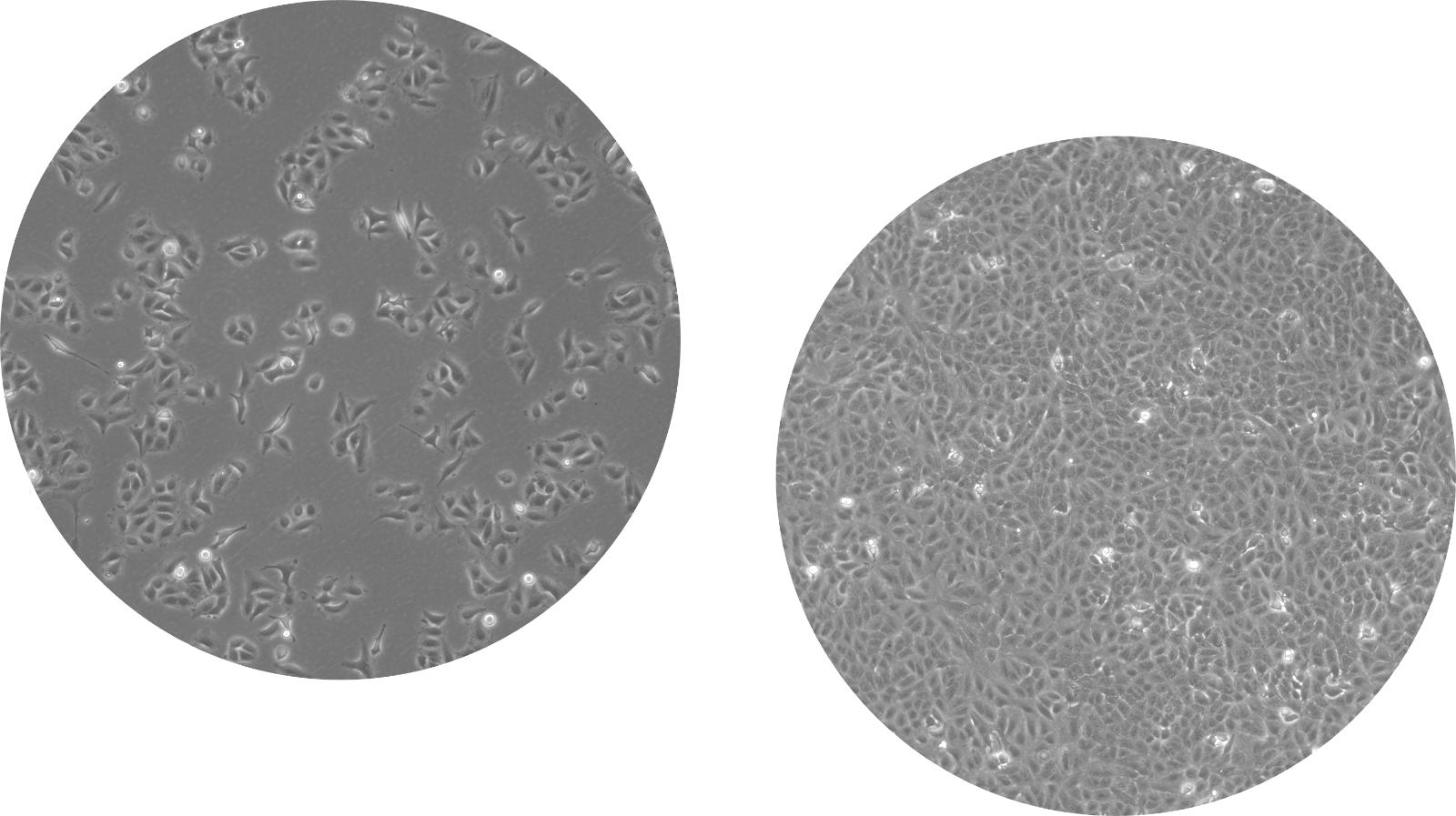
Subconfluent (left) and confluent (right) A549 cells.
A549: Cell Growth and Cell Cycle Regulation
A549 cell growth is a key area of study, especially in understanding how these cells progress through the cell cycle. The investigation into cell cycle genes and the impact of cell cycle inhibitors on A549 cells provides insights into the mechanisms of cancer cell proliferation. Techniques like cell sorting and the formation of cell pellets are essential in these studies, allowing researchers to isolate and analyze specific cell populations. Electron microscopy offers detailed imagery, further elucidating the cellular structures and processes at play.
Alternative Tissue Culture Models and Gene Expression Studies
As an alternative tissue culture model, A549 cells mimic the ATII cell phenotype, displaying ATII differentiation characteristics. This makes them particularly useful for studying human ATII cells and surfactant protein genes. Advanced techniques such as microarray gene expression and RNA expression ATP analyses facilitate comprehensive comparisons of gene expression between A549 cells and primary human lung cells, including endothelial cells. These comparisons are crucial for understanding cancer at a molecular level and for developing targeted therapies.
Chemotherapy Resistance and Treatment Efficacy
The role of A549 cells in NSCLC chemotherapy resistance research is notable, especially concerning drugs like cisplatin and pemetrexed. Studies often focus on the mechanisms behind chemotherapy resistance, with a particular interest in cassette lipid transporters and the impact of genetic factors on drug efficacy. The efficacy of alternative treatments, such as glutathione esters and the potential use of botulinum neurotoxin mechanisms, is also explored within this context.
A549 Cell Line Cultivation Guide
This section consolidates essential cultivation parameters and practices for the A549 cell line, providing a comprehensive resource for optimal culture conditions. It covers key aspects such as population doubling time, adherence properties, optimal seeding densities, preferred growth media compositions, and standard culturing environments.
Cultivation Parameters
Population Doubling Time: Approximately 28 hours, indicating the time required for the cell population to double in number.
Adherence Characteristics: A549 is an adherent cell line, forming monolayers, which facilitates direct observation and manipulation.
Seeding Density: An initial seeding density of 1 x 10^4 cells/cm^2 is recommended to ensure optimal growth conditions and cell confluency.
Growth Medium: A nourishing blend of DMEM and Ham's F12 medium (1:1), enriched with 10% Fetal Bovine Serum (FBS) and supplemented with L-glutamine, supports robust cell growth.
Culturing Conditions: Cultures thrive in a humidified atmosphere at 37°C, with a 5% CO2 balance, mimicking physiological conditions.
Storage Protocol: Cells are best preserved in the vapour phase of liquid nitrogen, ensuring long-term viability.
Cryopreservation and Recovery: Employing a controlled-rate freezing method with CM-ACF or CM-1 media safeguards cellular integrity during cryopreservation. Thawing involves rapid warming in a 37°C water bath, followed by centrifugation to remove cryoprotectant, and resuspension in fresh growth media.
Biosafety and Contamination Control
Biosafety Classification: Classified under Biosafety Level 1, A549 cells require standard microbiological practices to ensure safe handling.
Contamination Mitigation: While A549 cells, like other cultures, are prone to microbial contamination, adherence to strict aseptic techniques minimizes this risk. Changes in medium pH and turbidity can indicate bacterial presence, whereas mycoplasma infections, more insidious, necessitate regular testing due to their potential to compromise cellular physiology and experimental outcomes.
Unlock the potential of your research with our high-quality A549 cells

Advantages and Considerations in A549 Cell Line Utilization
The A549 cell line stands as a prominent model in lung cancer research, favored for its well-documented biological behavior and straightforward culturing requirements. However, vigilance against microbial contamination is paramount, as is the case with any in vitro model. Specifically, the risk of mycoplasma infection underscores the need for regular diagnostic screening. Furthermore, to maintain cellular integrity and reproducibility in experimental results, it is advisable to limit A549 cultures to a maximum of 20 passages.
A549 cells: Research Publications
In this section, you can explore a selection of notable publications on A549 lung carcinoma cells that may inspire new research ideas involving this cell line.
- A study conducted in 2020 aimed to develop suspension cultures of A549 cells to enhance the production of oncolytic adenoviruses, which are used for cancer therapy.
- This study used the A549 cell line to evaluate the anti-cancer potential of Hypnea valentiae seaweed-loaded green nanoparticles.
- This publication in the Bioengineered journal proposes C-met specific chimeric antigen receptor T cell as direct therapy for A549 non-small cell lung carcinoma cells.
- A549 cells were used for anti-cancer drug screening, specifically the role of gallic acid, a natural compound, in inducing cell death and preventing lung cancer progression.
- This research paper utilized the A549 cell line to validate the anti-tumor activity of combined paclitaxel and curcumin compound nanoformulations.
- This publication in the Cancer Management and Research journal employed A549 cells as a non-small lung cancer model and study the mechanism behind cisplatin resistance.
- This study explored the varying effect of human adenovirus early region (E1A) protein isoforms on aerobic glycolysis by using the A549 cell line as a cell model.
Resources for the A549 cell line
The A549 cell line, recognized for its origin from lung carcinoma epithelial cells, is extensively documented within the scientific community. A wealth of information is available, encompassing detailed protocols for culturing, transfection techniques, and other critical experimental procedures, making it a valuable resource for researchers in the field of cancer biology and related disciplines.
A549: Transfection protocols
Transfection protocol: This site provides all necessary information for transfecting A549 cells.
Transfection of A549 cells: This link will lead to a DNA transfection protocol for the A549 cell line.
Transfection protocol: A general DNA transfection protocol for mammalian cell lines is shown in this video.
Videos about the A549 cell line
Cell culture protocol for A549 cells: This video is about culturing the human lung carcinoma cell line A549.
A549 general information: This video provides some basic information about the A549 cell line.
With this comprehensive guide to the A549 cell line, you have all the necessary information to use this powerful tool in your research. Whether you're exploring cancer, toxicology, or immuno-oncology, A549 cells offer a reliable and well-characterized model. If you're ready to get started, don't hesitate to reach out to us or order from our website today. We can't wait to see the groundbreaking discoveries that you'll uncover with A549 cells.
References
- Moreira, A.S., et al., Establishing suspension cell cultures for improved manufacturing of oncolytic adenovirus. Biotechnology Journal, 2020, 15(4): p. 1900411.
- Calderón-Montaño, J.M., et al., Screening for selective anticancer activity of 65 extracts of plants collected in Western Andalusia, Spain. Plants, 2021, 10(10): p. 2193.
- Viswanathan, S., et al., Anti-cancer activity of Hypnea valentiae seaweed-loaded gold nanoparticles through the EMT signaling pathway in A549 cells. Biochemical Systematics and Ecology, 2023, 107, p. 104606.
- Garcia-de-Alba, C., Repurposing A549 adenocarcinoma cells: New options for drug discovery. 2021, American Thoracic Society, p. 405–406.
- Qi, L., et al., In vivo tumor growth and spontaneous metastasis assays using A549 lung cancer cells. Bio-protocol, 2020. 10(7): p. e3579-e3579.
- Khan, P., et al., Culture of human alveolar epithelial type II cells by sprouting. Respiratory research, 2018. 19(1): p. 1-7.