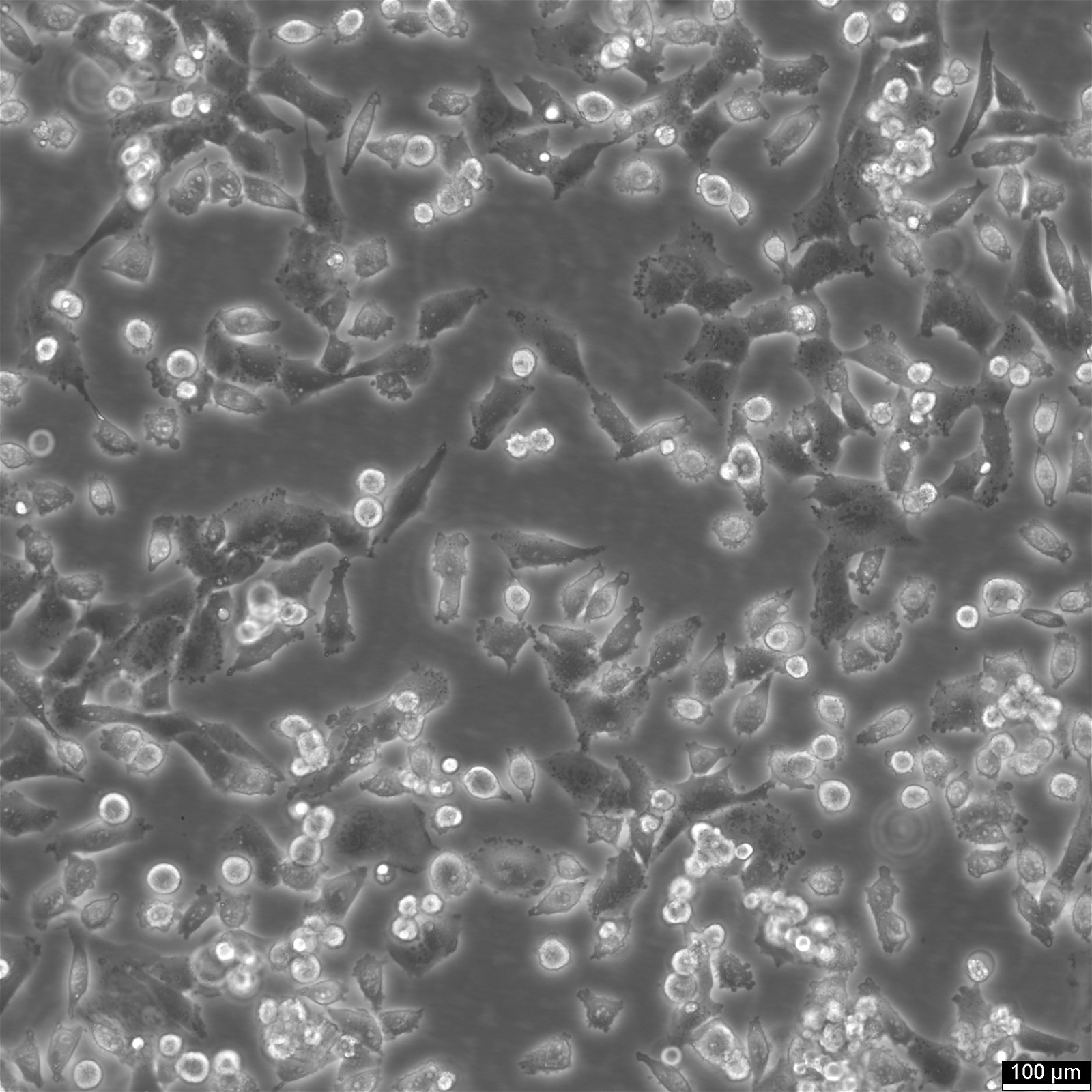
UM-HMC-3B cells
USD$700.00*
Products are shipped frozen on dry ice in cryotubes. Each cryotube typically contains 3 × 10⁶ cells for adherent lines or 5 × 10⁶ cells for suspension lines (refer to the batch CoA for details).
General information
| Description | UM-HMC-3B is a human mucoepidermoid carcinoma cell line established from a primary mucoepidermoid carcinoma of the hard palate salivary glands of a 73-year-old Caucasian female patient. The line is is part of the University of Michigan Human Mucoepidermoid Carcinoma (UM-HMC) panel. Like UM-HMC-1, UM-HMC-3B harbors the CRTC1-MAML2 gene fusion (MECT1-MAML2), the oncogenic driver in the majority of mucoepidermoid carcinomas, which results from a t(11;19)(q21;p13) translocation and drives CREB and Notch pathway activation. UM-HMC-3B is applicable in studies of hard palate and salivary gland mucoepidermoid carcinoma biology, CRTC1-MAML2 signalling, and comparative analyses with other UM-HMC panel lines. Together with UM-HMC-1 and other panel members, UM-HMC-3B enables identification of common and divergent molecular features across mucoepidermoid carcinomas of different anatomical sites, ages, and genders. It is also suitable for drug sensitivity assays targeting fusion oncoproteins and downstream CREB/Notch effectors. |
|---|---|
| Organism | Human |
| Tissue | Hard palate, salivary gland |
| Disease | Hard palate mucoepidermoid carcinoma |
| Metastatic site | Primary tumor site (hard palate) |
| Applications | Salivary gland carcinoma research; CRTC1-MAML2 fusion biology; hard palate MEC biology; CREB/Notch pathway; comparative UM-HMC panel studies; drug sensitivity assays |
| Synonyms | University of Michigan-Human Mucoepidermoid Carcinoma-3B |
Characteristics
| Age | 73 years |
|---|---|
| Gender | Female |
| Ethnicity | Caucasian |
| Morphology | Epithelial-like |
| Cell type | Epithelial cells |
| Growth properties | Adherent |
Regulatory Data
| Citation | UM-HMC-3B (Cytion catalog number 305715) |
|---|---|
| Biosafety level | 1 |
| NCBI_TaxID | 9606 |
| CellosaurusAccession | CVCL_Y472 |
| GMO Status | No genetic modification; somatic CRTC1-MAML2 fusion acquired during tumor development |
Biomolecular Data
| Mutational profile | Mutation: Gene fusion, CRTC1 + HGNC, MAML2, Name(s)=CRTC1-MAML2, MECT1-MAML2. |
|---|
Handling
| Culture Medium | DMEM:Ham's F12 (1:1), w: 3.1 g/L Glucose, w: 2.5 mM L-Glutamine, w: 15 mM HEPES, w: 0.5 mM Sodium pyruvate, w: 1.2 g/L NaHCO3 (Cytion article number 820400a) |
|---|---|
| Supplements | Supplement the medium with 10% FBS |
| Dissociation Reagent | Accutase |
| Doubling time | approx. 24 to 48 hours |
| Subculturing | Remove medium, wash with PBS without calcium and magnesium, cover with Accutase, incubate 8–10 min at RT, resuspend in medium, centrifuge 300×g 3 min, discard supernatant, reseed in fresh medium. |
| Split ratio | 1 to 5 |
| Seeding density | 2-4*10^4/cm² |
| Fluid renewal | Every 2 to 3 days |
| Freeze medium | As a cryopreservation medium, we use complete growth medium (including FBS) + 10% DMSO for adequate post-thaw viability, or CM-1 (Cytion catalog number 800100), which includes optimized osmoprotectants and metabolic stabilizers to enhance recovery and reduce cryo-induced stress. |
| Thawing and Culturing Cells |
|
| Incubation Atmosphere | 37°C, 5% CO2, humidified atmosphere. |
| Flask Coating | Use Collagen coated flasks |
| Shipping Conditions | Cryopreserved cell lines are shipped on dry ice in validated, insulated packaging with sufficient refrigerant to maintain approximately −78 °C throughout transit. On receipt, inspect the container immediately and transfer vials without delay to appropriate storage. |
| Storage Conditions | For long-term preservation, place vials in vapor-phase liquid nitrogen at about −150 to −196 °C. Storage at −80 °C is acceptable only as a short interim step before transfer to liquid nitrogen. |
Quality Control & Molecular Analysis
| Sterility | Mycoplasma contamination is excluded using both PCR-based assays and luminescence-based mycoplasma detection methods. To ensure there is no bacterial, fungal, or yeast contamination, cell cultures are subjected to daily visual inspections. |
|---|
-
Related products
Related products
UM-HMC-1 CellsOrganism Human Tissue Salivary gland, anterior buccal gland Disease Salivary gland mucoepidermoid carcinoma USD$800.00*UM-HMC-3A CellsOrganism Human Tissue Oral cavity, hard palate Disease Hard palate mucoepidermoid carcinoma USD$700.00*