
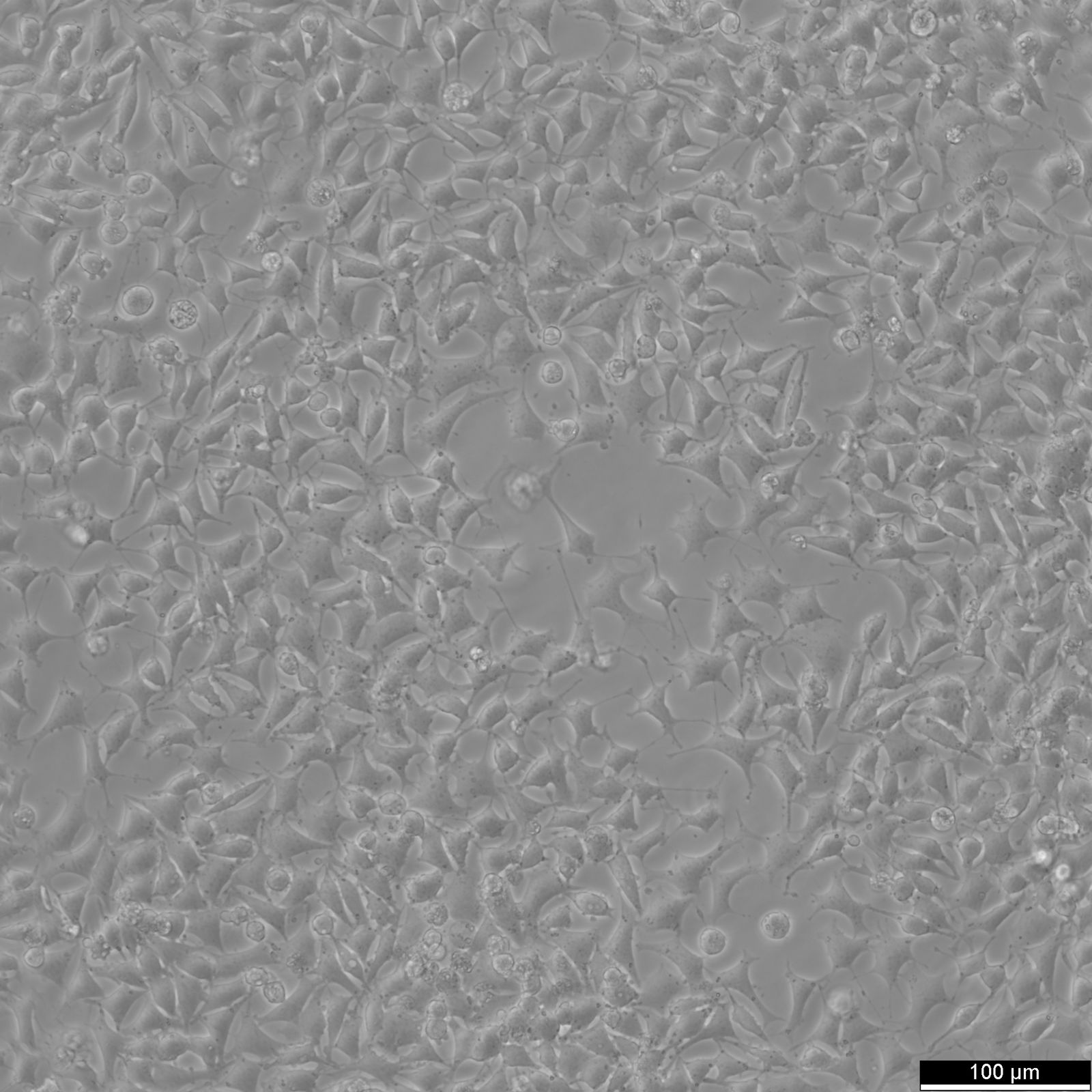
RLE-6TN Cells
USD$395.00*
Products are shipped frozen on dry ice in cryotubes. Each cryotube typically contains 3 × 10⁶ cells for adherent lines or 5 × 10⁶ cells for suspension lines (refer to the batch CoA for details).
General information
| Description | The RLE-6TN cell line is an immortalized rat alveolar type II epithelial cell line derived from adult Fischer 344 rats. RLE-6TN was established through spontaneous immortalization during attempts to introduce the SV40-T antigen gene into primary alveolar type II epithelial cells. Unlike its counterpart RLE-6T, which was positively transfected with the SV40-T antigen, RLE-6TN cells do not express the T-antigen gene. Despite this, RLE-6TN cells retain critical morphological and functional features characteristic of alveolar type II cells, including cytokeratin expression and the presence of lipid-containing lamellar inclusion bodies. RLE-6TN cells have been widely used as an in vitro model for investigating lung epithelial cell biology, alveolar function, and responses to various physiological and pathological stimuli. They are particularly relevant for studying Na-K-ATPase regulation and activity in alveolar epithelial cells. Na-K-ATPase is essential for maintaining cellular ion gradients and trans-epithelial ion transport, processes critical for alveolar fluid clearance in the lungs. In studies, thyroid hormone (T3) has been shown to stimulate Na-K-ATPase activity in RLE-6TN cells by enhancing its translocation to the plasma membrane rather than increasing its transcription, highlighting a novel, rapid regulatory mechanism. RLE-6TN cells demonstrate stable growth, with near-diploid karyotype stability, and are not tumorigenic in nude mice. They are negative for alkaline phosphatase activity but stain positive for cytokeratins 8, 18, and 19, confirming their epithelial origin. RLE-6TN cells can be maintained long-term in culture and serve as a reliable platform for mechanistic studies on alveolar epithelial repair, surfactant metabolism, and cellular responses to lung injury, toxins, and therapeutic agents. |
|---|---|
| Organism | Rat |
| Tissue | Lung |
| Synonyms | Rat Lung Epithelial-6-T-antigen Negative |
Characteristics
| Age | 56 days |
|---|---|
| Gender | Male |
| Morphology | Epithelial |
| Growth properties | Adherent |
Regulatory Data
| Citation | RLE-6TN (Cytion catalog number 305350) |
|---|---|
| Biosafety level | 1 |
| NCBI_TaxID | 10116 |
| CellosaurusAccession | CVCL_4693 |
Biomolecular Data
| Antigen expression | Cytokeratin 8; cytokeratin 19 |
|---|---|
| Tumorigenic | No, No not tumorgenic in nude mice |
| Viruses | SV40 |
| Karyotype | Cells are reported to remain near diploid and karyotypically stable from passage 19-70 with 50% or more of the cells containing 42 chromosomes. At passage 37, there was a translocation between chromosome 1 and 15 which results in trisomy of the q arm of chromosome 1. |
Handling
| Culture Medium | DMEM:Ham's F12 (1:1), w: 3.1 g/L Glucose, w: 2.5 mM L-Glutamine, w: 15 mM HEPES, w: 0.5 mM Sodium pyruvate, w: 1.2 g/L NaHCO3 (Cytion article number 820400a) |
|---|---|
| Supplements | Supplement the medium with 5% FBS |
| Dissociation Reagent | Accutase |
| Fluid renewal | 2 to 3 times per week |
| Freeze medium | As a cryopreservation medium, we use complete growth medium (including FBS) + 10% DMSO for adequate post-thaw viability, or CM-1 (Cytion catalog number 800100), which includes optimized osmoprotectants and metabolic stabilizers to enhance recovery and reduce cryo-induced stress. |
| Thawing and Culturing Cells |
|
| Incubation Atmosphere | 37°C, 5% CO2, humidified atmosphere. |
| Shipping Conditions | Cryopreserved cell lines are shipped on dry ice in validated, insulated packaging with sufficient refrigerant to maintain approximately −78 °C throughout transit. On receipt, inspect the container immediately and transfer vials without delay to appropriate storage. |
| Storage Conditions | For long-term preservation, place vials in vapor-phase liquid nitrogen at about −150 to −196 °C. Storage at −80 °C is acceptable only as a short interim step before transfer to liquid nitrogen. |
Quality Control & Molecular Analysis
| Sterility | Mycoplasma contamination is excluded using both PCR-based assays and luminescence-based mycoplasma detection methods. To ensure there is no bacterial, fungal, or yeast contamination, cell cultures are subjected to daily visual inspections. |
|---|
Certificate of Analysis (CoA)
| Lot Number | Certificate Type | Date | Catalog Number |
|---|---|---|---|
| 305350-150125 | Certificate of Analysis | 23. May. 2025 | 305350 |