
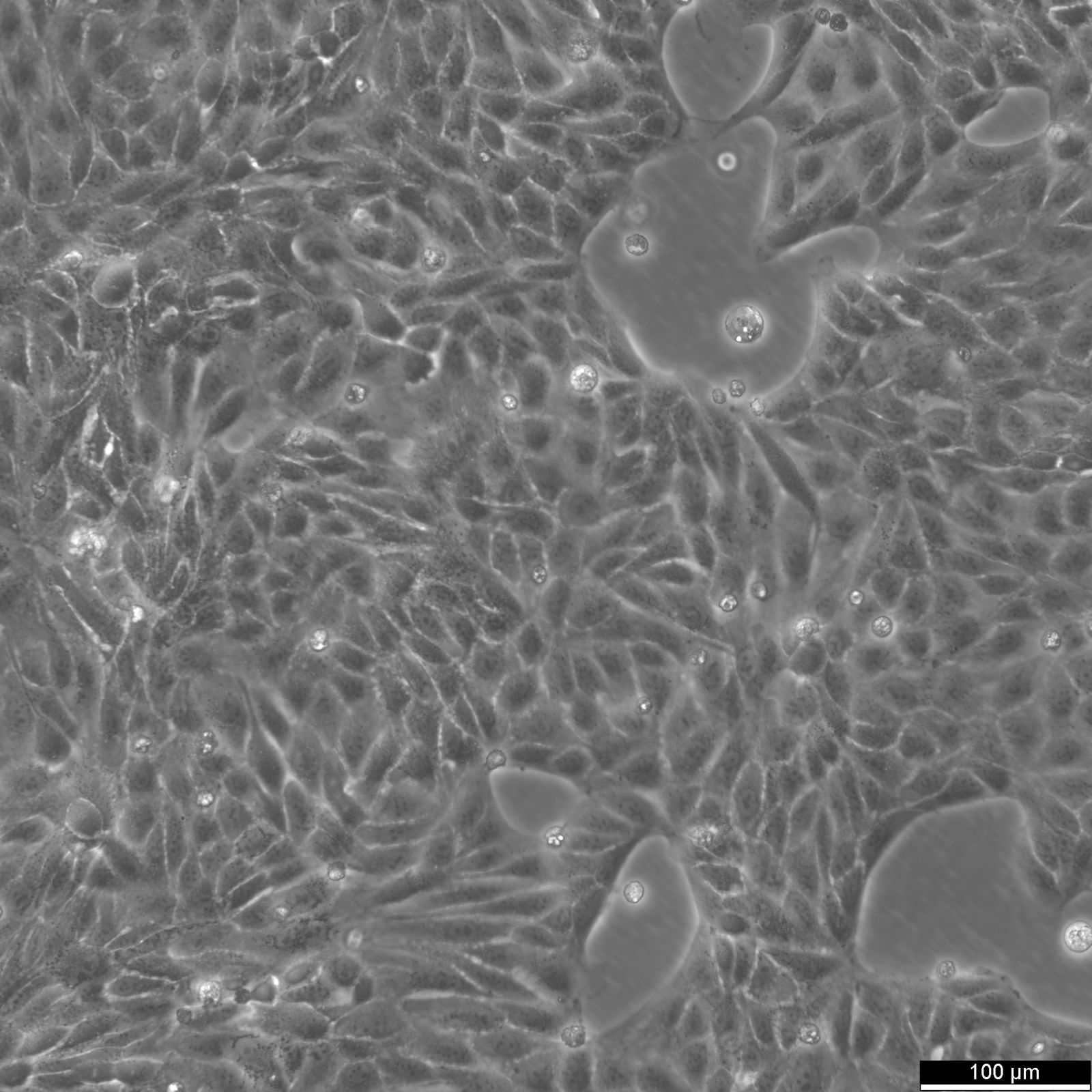
MDCK-II Cells
USD 395.00*
Products are shipped frozen on dry ice in cryotubes. Each cryotube typically contains 3 × 10⁶ cells for adherent lines or 5 × 10⁶ cells for suspension lines (refer to the batch CoA for details).
Información general
| Descripción | Madin-Darby Canine Kidney type II (MDCK-II) cells are an epithelial cell line derived from the kidney of an adult female cocker spaniel. These cells are widely used in biomedical research due to their unique ability to form tight junctions and polarized monolayers, which are characteristic features of epithelial tissues. MDCK-II cells exhibit robust growth and differentiation properties, making them an excellent model for studying epithelial cell biology, including cell polarity, transport processes, and barrier function. The MDCK-II cell line is particularly valuable for investigating the mechanisms of virus-host interactions, especially for influenza virus research. The cells' ability to form polarized monolayers makes them ideal for studying the directional release and spread of viruses. Additionally, MDCK-II cells are frequently employed in drug transport and toxicity studies, as their well-defined tight junctions provide a reliable model for assessing the permeability and barrier function of epithelial cells. Their responsiveness to various growth factors and hormones further enhances their utility in diverse research applications. Researchers also use MDCK-II cells to explore renal physiology and pathophysiology, given their origin from kidney tissue. This cell line provides insights into kidney epithelial cell function, including ion transport, fluid regulation, and cellular responses to injury. Overall, MDCK-II cells are a versatile and essential tool in the study of epithelial cell biology and related biomedical fields. |
|---|---|
| Organismo | Canine |
| Tejido | Kidney |
| Enfermedad | Normal kidney epithelium |
| Aplicaciones | Virology; epithelial transport studies; tight junction research; drug permeability assays; cell biology |
| Sinónimos | MDCK II, MDCKII, MDCK2, MDCK-2, MDCK Type II, MDCKII-WT |
Características
| Raza/Subespecie | Cocker Spaniel |
|---|---|
| Edad | Adult |
| Género | Female |
| Morfología | Epithelial-like |
| Tipo de célula | Epithelial |
| Propiedades de crecimiento | Adherent |
Datos normativos
| Referencia | MDCK-II (Cytion catalog number 305233) |
|---|---|
| Nivel de bioseguridad | 1 |
| NCBI_TaxID | 9615 |
| N.º de acceso de Cellosaurus | CVCL_0424 |
| Estado de los OGM | No genetic modification; wildtype cell line |
Datos biomoleculares
Manejo
| Medio de cultivo | EMEM (MEM Eagle), w: 2 mM L-Glutamine, w: 2.2 g/L NaHCO3, w: EBSS (Cytion article number 820100a) |
|---|---|
| Suplementos | Supplement the medium with 10% FBS and 1% NEAA |
| Reactivo de disociación | Accutase |
| Tiempo de duplicación | approx. 16-20 hours |
| Subcultivo | Remove the old medium from the adherent cells and wash them with PBS that lacks calcium and magnesium. For T25 flasks, use 3-5 ml of PBS, and for T75 flasks, use 5-10 ml. Then, cover the cells completely with Accutase, using 1-2 ml for T25 flasks and 2.5 ml for T75 flasks. Let the cells incubate at room temperature for 8-10 minutes to detach them. After incubation, gently mix the cells with 10 ml of medium to resuspend them, then centrifuge at 300xg for 3 minutes. Discard the supernatant, resuspend the cells in fresh medium, and transfer them into new flasks that already contain fresh medium. |
| Relación de división | 1 to 5 |
| Densidad de siembra | 2 to 5 x 10⁴ cells/cm2 |
| Renovación de fluidos | 2 to 3 times per week |
| Medio de congelación | As a cryopreservation medium, we use complete growth medium (including FBS) + 10% DMSO for adequate post-thaw viability, or CM-1 (Cytion catalog number 800100), which includes optimized osmoprotectants and metabolic stabilizers to enhance recovery and reduce cryo-induced stress. |
| Descongelación y cultivo de células |
|
| Atmósfera de incubación | 37°C, 5% CO2, humidified atmosphere. |
| Condiciones de envío | Cryopreserved cell lines are shipped on dry ice in validated, insulated packaging with sufficient refrigerant to maintain approximately −78 °C throughout transit. On receipt, inspect the container immediately and transfer vials without delay to appropriate storage. |
| Condiciones de almacenamiento | For long-term preservation, place vials in vapor-phase liquid nitrogen at about −150 to −196 °C. Storage at −80 °C is acceptable only as a short interim step before transfer to liquid nitrogen. |
Control de calidad y análisis molecular
| Esterilidad | Mycoplasma contamination is excluded using both PCR-based assays and luminescence-based mycoplasma detection methods. To ensure there is no bacterial, fungal, or yeast contamination, cell cultures are subjected to daily visual inspections. |
|---|
Certificado de análisis (CoA)
| Número de lote | Tipo de certificado | Fecha | Número de catálogo |
|---|---|---|---|
| 305233-230824 | Certificado de análisis | 26. May. 2025 | 305233 |