
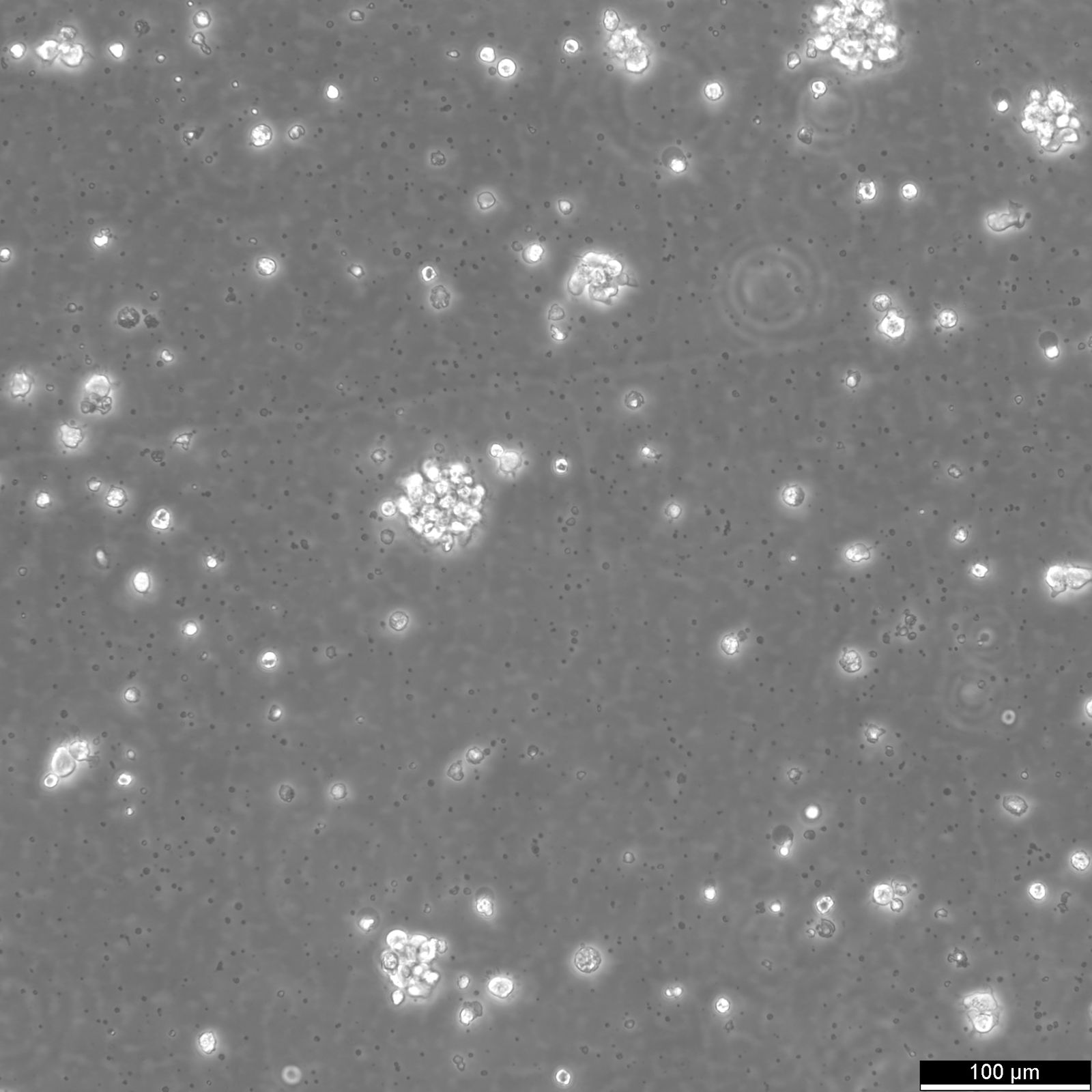
TMD8 Cells
CAD$545.10*
Products are shipped frozen on dry ice in cryotubes. Each cryotube typically contains 3 × 10⁶ cells for adherent lines or 5 × 10⁶ cells for suspension lines (refer to the batch CoA for details).
General information
| Description | The TMD8 cell line is a human diffuse large B-cell lymphoma (DLBCL) model representative of the activated B-cell-like (ABC) subtype. This subtype is characterized by constitutive activation of the NF-κB pathway, which is essential for cell survival. TMD8 exhibits wild-type CARD11, yet maintains strong NF-κB activity, indicating a dependency on chronic active B-cell receptor (BCR) signaling. This dependency is supported by experimental evidence showing that knockdown of BCR pathway components—including BTK, CD79A, CD79B, and IgM—leads to cell death in TMD8 cells. Additionally, TMD8 harbors a Y196H mutation in the ITAM domain of CD79B, a mutation commonly found in ABC-DLBCLs that enhances surface BCR expression and attenuates negative feedback from Lyn kinase, thus promoting sustained signaling activity. TMD8 cells also demonstrate notable sensitivity to BCL-2 inhibition via venetoclax when expressing high levels of the BCL-2 protein. However, resistance to venetoclax in such cells can be mediated by activation of the PI3K/AKT pathway, particularly following prolonged drug exposure. This resistance mechanism involves a reduction in PTEN expression and increased AKT phosphorylation. TMD8 cells with acquired resistance to venetoclax exhibit heightened susceptibility to pharmacological PI3K/AKT pathway inhibition, making them a suitable model for studying therapeutic combinations aimed at overcoming resistance in aggressive B-cell lymphomas. |
|---|---|
| Organism | Human |
| Tissue | Bone marrow |
| Disease | Diffuse large B-cell lymphoma activated B-cell type |
| Synonyms | TMD-8, Tokyo Medical and Dental university 8 |
Characteristics
| Age | 62 years |
|---|---|
| Gender | Male |
| Ethnicity | Japanese |
| Growth properties | Suspension |
Regulatory Data
| Citation | TMD8 (Cytion catalog number 305729) |
|---|---|
| Biosafety level | 1 |
| NCBI_TaxID | 9606 |
| CellosaurusAccession | CVCL_A442 |
Biomolecular Data
| Mutational profile | Mutation: CD79B, Simple, p.Tyr196His (c.586T>C), Heterozygous, M yearsD88, Simple, p.Leu252Pro (c.755T>C) (L265P), Heterozygous |
|---|
Handling
| Culture Medium | RPMI 1640, w: 2.0 mM stable Glutamine, w: 2.0 g/L NaHCO3 (Cytion article number 820700a) |
|---|---|
| Supplements | Supplement the medium with 10% FBS |
| Doubling time | ~30 hours |
| Freeze medium | As a cryopreservation medium, we use complete growth medium (including FBS) + 10% DMSO for adequate post-thaw viability, or CM-1 (Cytion catalog number 800100), which includes optimized osmoprotectants and metabolic stabilizers to enhance recovery and reduce cryo-induced stress. |
| Thawing and Culturing Cells |
|
| Incubation Atmosphere | 37°C, 5% CO2, humidified atmosphere. |
| Shipping Conditions | Cryopreserved cell lines are shipped on dry ice in validated, insulated packaging with sufficient refrigerant to maintain approximately −78 °C throughout transit. On receipt, inspect the container immediately and transfer vials without delay to appropriate storage. |
| Storage Conditions | For long-term preservation, place vials in vapor-phase liquid nitrogen at about −150 to −196 °C. Storage at −80 °C is acceptable only as a short interim step before transfer to liquid nitrogen. |
Quality Control & Molecular Analysis
| Sterility | Mycoplasma contamination is excluded using both PCR-based assays and luminescence-based mycoplasma detection methods. To ensure there is no bacterial, fungal, or yeast contamination, cell cultures are subjected to daily visual inspections. |
|---|
Certificate of Analysis (CoA)
| Lot Number | Certificate Type | Date | Catalog Number |
|---|---|---|---|
| 305729-150925 | Certificate of Analysis | 05. Dec. 2025 | 305729 |
| 305729-280425 | Certificate of Analysis | 18. Aug. 2025 | 305729 |