
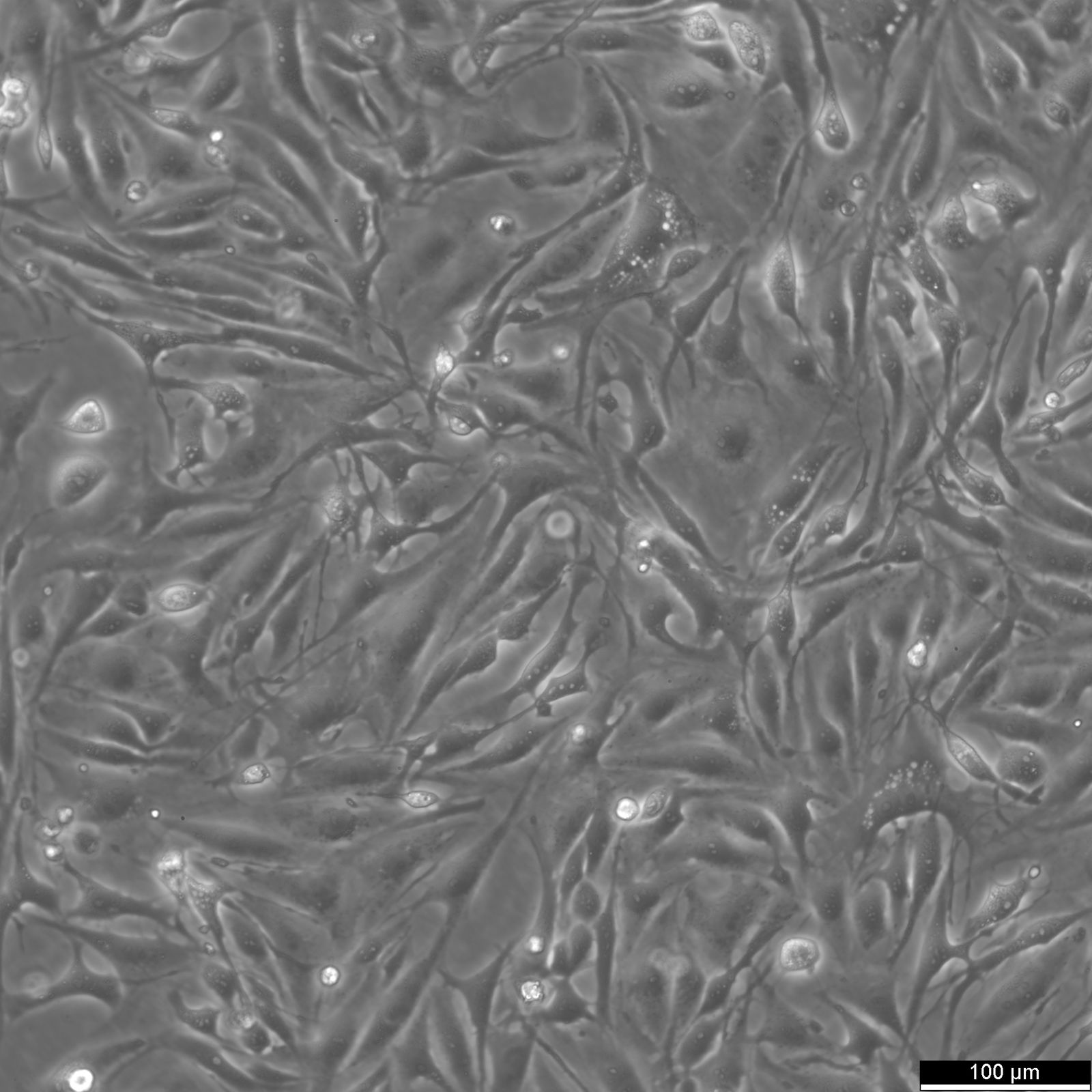
Bend.3 Cells
CAD$545.10*
Products are shipped frozen on dry ice in cryotubes. Each cryotube typically contains 3 × 10⁶ cells for adherent lines or 5 × 10⁶ cells for suspension lines (refer to the batch CoA for details).
General information
| Description | The Bend.3 cell line is derived from mouse brain endothelial cells and is widely utilized in neurovascular research. These cells serve as a model for studying the blood-brain barrier (BBB), a critical structure that regulates the passage of substances from the bloodstream into the brain. Bend.3 cells are instrumental in exploring the molecular and cellular mechanisms governing BBB integrity, permeability, and transport functions. Researchers use Bend.3 cells to investigate the pathophysiology of various neurological disorders, such as stroke, Alzheimer's disease, and multiple sclerosis, where BBB dysfunction is a hallmark. Bend.3 cells exhibit endothelial characteristics, including the expression of tight junction proteins such as occludin, claudins, and zonula occludens-1 (ZO-1), which are essential for maintaining the selective permeability of the BBB. They also express markers like CD31 and von Willebrand factor, typical of endothelial cells. Bend.3 cells respond to inflammatory stimuli and oxidative stress, making them suitable for studies on BBB disruption and neuroinflammation. Additionally, this cell line is used to assess the efficacy and safety of pharmacological agents intended to cross the BBB, aiding in the development of treatments for central nervous system disorders. The utility of Bend.3 cells in modeling the neurovascular unit underscores their importance in advancing our understanding of brain endothelial cell biology and the development of neurotherapeutics. |
|---|---|
| Organism | Mouse |
| Tissue | Brain, cerebral cortex |
| Disease | Endothelioma |
| Synonyms | bEND.3, b.End3, bEnd.3, bEnd3, BEND3, brain-derived Endothelial cells.3 |
Characteristics
| Breed/Subspecies | BALB/c |
|---|---|
| Age | 6 weeks |
| Gender | Unspecified |
| Morphology | Endothelial |
| Cell type | Endothelial cell |
| Growth properties | Adherent |
Regulatory Data
| Citation | Bend.3 (Cytion catalog number 305265) |
|---|---|
| Biosafety level | 1 |
| NCBI_TaxID | 10090 |
| CellosaurusAccession | CVCL_0170 |
| GMO Status | GMO-S1: This murine endothelial cell line (bEnd.3) contains a polyomavirus middle T antigen encoded by the NTKmT retroviral vector, driving transformation and enhanced proliferation. The construct is stably present in brain microvascular endothelial cells. This classification applies only within Germany and may differ elsewhere. |
Biomolecular Data
| Antigen expression | ICAM-1 +, VCAM-1 +, MAdCAM-1 + |
|---|---|
| Viruses | Transformant: Murine polyomavirus (strain A2) (MPyV) middle T antigen (PyMT) |
Handling
| Culture Medium | DMEM, w: 4.5 g/L Glucose, w: 4 mM L-Glutamine, w: 3.7 g/L NaHCO3, w: 1.0 mM Sodium pyruvate (Cytion article number 820300a) |
|---|---|
| Supplements | Supplement the medium with 10% FBS |
| Dissociation Reagent | Accutase |
| Subculturing | Remove the old medium from the adherent cells and wash them with PBS that lacks calcium and magnesium. For T25 flasks, use 3-5 ml of PBS, and for T75 flasks, use 5-10 ml. Then, cover the cells completely with Accutase, using 1-2 ml for T25 flasks and 2.5 ml for T75 flasks. Let the cells incubate at room temperature for 8-10 minutes to detach them. After incubation, gently mix the cells with 10 ml of medium to resuspend them, then centrifuge at 300xg for 3 minutes. Discard the supernatant, resuspend the cells in fresh medium, and transfer them into new flasks that already contain fresh medium. |
| Freeze medium | As a cryopreservation medium, we use complete growth medium (including FBS) + 10% DMSO for adequate post-thaw viability, or CM-1 (Cytion catalog number 800100), which includes optimized osmoprotectants and metabolic stabilizers to enhance recovery and reduce cryo-induced stress. |
| Thawing and Culturing Cells |
|
| Incubation Atmosphere | 37°C, 5% CO2, humidified atmosphere. |
| Shipping Conditions | Cryopreserved cell lines are shipped on dry ice in validated, insulated packaging with sufficient refrigerant to maintain approximately −78 °C throughout transit. On receipt, inspect the container immediately and transfer vials without delay to appropriate storage. |
| Storage Conditions | For long-term preservation, place vials in vapor-phase liquid nitrogen at about −150 to −196 °C. Storage at −80 °C is acceptable only as a short interim step before transfer to liquid nitrogen. |
Quality Control & Molecular Analysis
| Sterility | Mycoplasma contamination is excluded using both PCR-based assays and luminescence-based mycoplasma detection methods. To ensure there is no bacterial, fungal, or yeast contamination, cell cultures are subjected to daily visual inspections. |
|---|
Certificate of Analysis (CoA)
| Lot Number | Certificate Type | Date | Catalog Number |
|---|---|---|---|
| 305265-260525 | Certificate of Analysis | 18. Aug. 2025 | 305265 |